The Cost Segregation Bill You Don't See Coming


.svg)
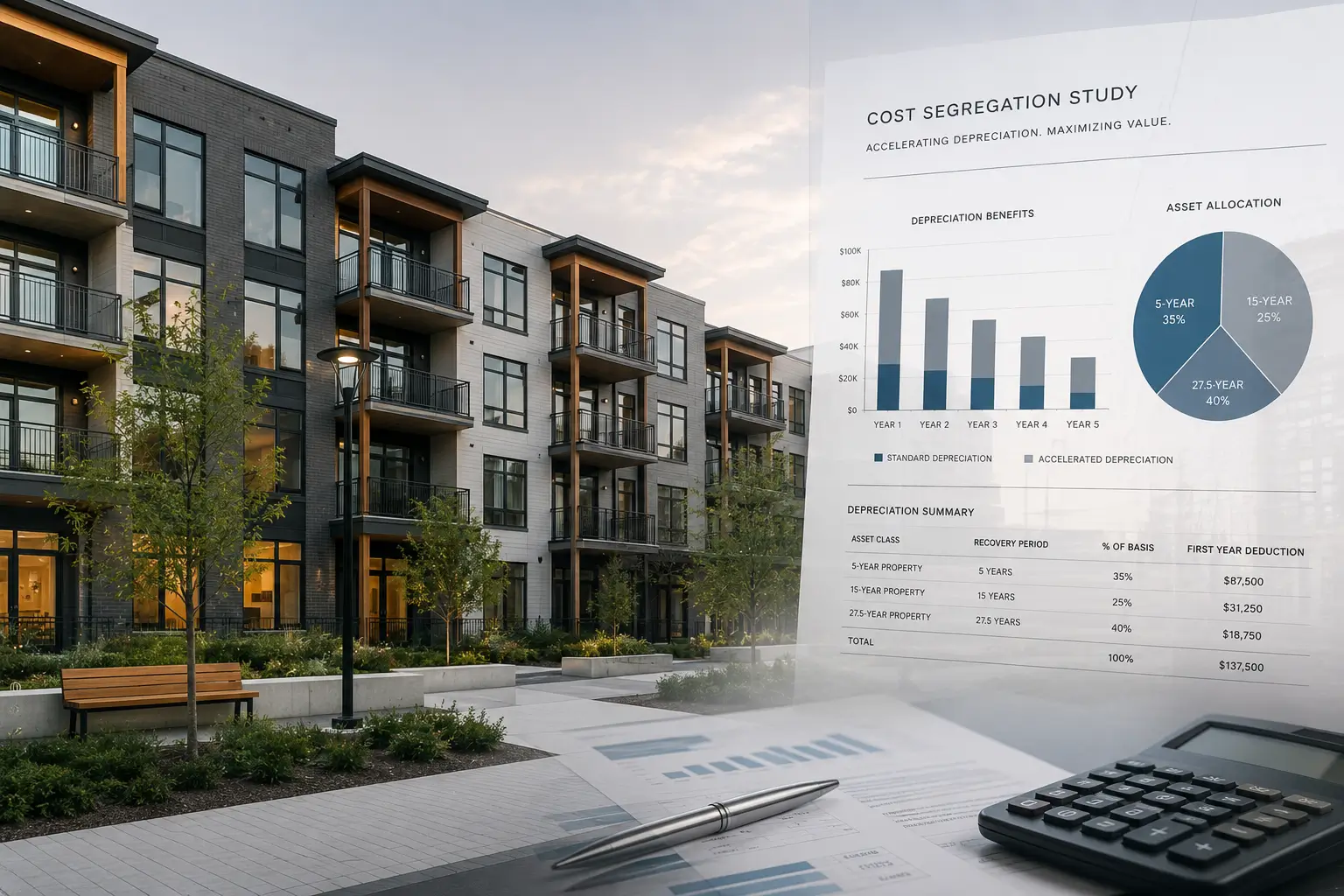
Cost segregation studies remain one of the most effective tax planning tools available to real estate investors. Reclassifying components of a $500,000 rental into 5 and 15 year property can generate substantial first-year deductions through bonus depreciation, often reducing an investor's tax liability by tens of thousands of dollars in the year of acquisition.
What frequently goes unaddressed is the tax consequence at disposition. Depreciation claimed today does not disappear. It resurfaces as depreciation recapture, and the components tied to a cost segregation study are recaptured under different rules than the building itself.
Two recapture regimes, one liability
Section 1250 property, the building structure, is recaptured at a flat 25% rate on sale. Most investors anticipate this.
The overlooked exposure is Section 1245 property: the 5 and 7 year assets a cost segregation study identifies, including carpeting, certain electrical and plumbing components, and specified land improvements. This portion is recaptured as ordinary income, taxed at the investor's marginal rate rather than the 25% unrecaptured Section 1250 rate or standard capital gains rates.
For an investor in the 32% bracket who accelerated $150,000 in depreciation through a cost segregation study, the ordinary income exposure on that component alone approaches $48,000, independent of capital gains tax and 1250 recapture on the remainder.
The strategic case remains sound
This does not undermine the case for cost segregation. The time value of accelerated deductions is real, and reinvested tax savings compound over the holding period. The exposure is not a flaw in the strategy. It is a deferral that requires planning at exit, not merely at acquisition.
Structuring around recapture
A 1031 exchange defers both capital gain and recapture by rolling proceeds into replacement property, subject to the 45-day identification window and 180-day closing deadline. This requires planning before a property is listed.
Holding property until death allows heirs to receive a stepped-up basis, eliminating the recapture liability entirely. This is not a standalone strategy, but a relevant consideration within broader estate planning for investors with substantial depreciated holdings.
Timing a disposition to coincide with a lower-income year reduces the marginal rate applied to the ordinary income component.
Most critically: recapture exposure should be quantified before a property is listed, not after an offer is accepted. I have seen net proceeds come in $40,000 below expectation on deals where this calculation was never run in advance.
The professional standard
Cost segregation and exit planning are two halves of the same strategy. An investor who accelerates depreciation without a corresponding exit plan is deferring a known liability without a plan to manage it. Before listing a property with a history of accelerated depreciation, the recapture calculation should be treated as a required step in pricing the deal, not an afterthought handled at closing.